







All articles by Neil Goalby – Page 2
-
 Resource
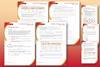
Reacting ratios: masses | Developing understanding | 14–16 years
Develop learners’ understanding of the ratio of the very large number of atoms or molecules in balanced chemical equations
-
 Resource
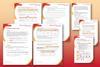
Cymarebau adweithio: masau | Datblygu dealltwriaeth | 14–16 oed
Datblygu dealltwriaeth dysgwyr o gymhareb y nifer mawr iawn o atomau neu foleciwlau mewn hafaliadau cemegol cytbwys
-
 Resource
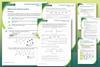
Diffusion and chemical reactions | Developing understanding | 11–14 years
Use this worksheet to deepen understanding of diffusion and chemical reactions and how these processes are represented
-
 Resource
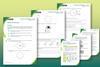
Diffusion and dissolving | Developing understanding | 11–14 years
Deepen learners’ understanding of diffusion and dissolving with this worksheet exploring different conceptual levels of thinking
-
 Resource
Melting and boiling points | Developing understanding | 11–14 years
Deepen understanding of melting and boiling points and how these are represented at different conceptual levels of thinking
-
 Resource
Solutions | Developing understanding | 11–14 years
Encourage learners to deepen their understanding of solutions and how they are represented at different conceptual levels of thinking
-
 Resource
States of matter | Developing understanding | 11–14 years
Encourage learners to deepen their understanding of states of matter and how they are represented at different conceptual levels of thinking
-
 Resource
Atomau ac isotopau | Datblygu dealltwriaeth | 14–16 oed
Anogwch y dysgwyr i ddyfnhau eu dealltwriaeth o isotopau o’r lefel facrosgopig i’r lefel is-ficrosgopig
-
 Resource
Atoms and isotopes | Developing understanding | 14–16 years
Encourage learners to deepen their understanding of isotopes from the macroscopic to sub-microscopic level
-
 Resource
Atoms and ions | Developing understanding | 14–16 years
Encourage learners to think about how atoms and ions are represented and what this means at the sub-microscopic level
-
 Resource
Atomau ac ïonau | Datblygu dealltwriaeth | 14–16 oed
Anogwch y dysgwyr i feddwl am sut mae atomau ac ionau’n cael eu cynrychioli a beth mae hyn yn ei olygu ar y lefel is-ficrosgopig
-
 Resource
Atomic structure | Developing understanding | 14–16 years
Encourage learners to think about how the atomic structure is represented and what this means at the sub-microscopic level
-
 Resource
Adeiledd atomig | Datblygu dealltwriaeth | 14–16 oed
Anogwch y dysgwyr i feddwl am sut mae adeiledd atomig yn cael ei gynrychioli a beth mae hyn yn ei olygu ar y lefel is-ficrosgopig
-
 Resource
Bondio cofalent | Datblygu dealltwriaeth | 14–16 oed
Datblygu dealltwriaeth y dysgwyr o faint a siâp adeileddau cofalent drwy ddehongli amrywiaeth o ddiagramau a modelau
-
 Resource
Covalent bonding | Developing understanding | 14–16 years
Develop learners’ understanding of the size and shape of covalent structures by interpreting a range of diagrams and models
-
 Resource
Ionic bonding | Developing understanding | 14–16 years
Develop learners’ understanding of ionic lattices through comparing 2D and 3D representations
-
 Resource
Bondio metelig | Datblygu dealltwriaeth | 14–16 oed
Datblygu dealltwriaeth is-ficrosgopig dysgwyr drwy ddehongli amrywiaeth o fodelau a ddefnyddir i gynrychioli adeiledd metelig ac ïonau metel
-
 Resource
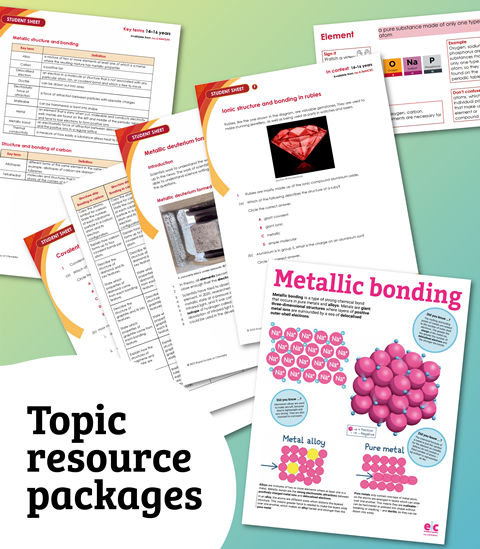
Metallic bonding | Developing understanding | 14–16 years
Develop learners’ sub-microscopic understanding by interpreting a range of models used to represent metallic structure and metal ions
-
 Resource
Carbon allotropes | Developing understanding | 14–16 years
Encourage learners to think about how different structures of carbon are represented and what this means at the sub-microscopic level
-
 Resource
Adeiledd Carbon Datblygu dealltwriaeth | 14–16 oed
Anogwch y dysgwyr i feddwl am sut mae atomau ac ionau’n cael eu cynrychioli a beth mae hyn yn ei olygu ar y lefel is-ficrosgopig