







All RSC Education articles in Non-EiC content – Page 5
-
 Resource
28 chemistry puzzles for 11-14 years
Try these sudoku-style chemistry puzzles for 11–14 year olds to reinforce your students’ understanding of key ideas, featuring printable worksheets and answers.
-
 Resource
45 chemistry puzzles for 16-18 years
Try these chemistry puzzles based on sudoku to help 16–18 year old students consolidate their knowledge about key topics, with printable worksheets and answers.
-
 Resource
28 o bosau cemeg i fyfyrwyr 14–16 oed
Defnyddiwch y posau hyn, sydd wedi’u hysbrydoli gan sudoku, ynghyd â’r taflenni gwaith a’r atebion y gallwch eu hargraffu, i helpu pobl ifanc 14–16 oed i gyfnerthu eu dealltwriaeth o gysyniadau cemegol allweddol.
-
 Resource
28 chemistry puzzles for 14-16 years
Use these sudoku-inspired puzzles with printable worksheets and answers to help 14–16 year olds consolidate their understanding of key chemical concepts.
-
 Resource
Gemau grid: 101 o bosau cemeg y gallwch eu hargraffu
Archwiliwch y posau cemeg hyn, sy’n debyg i bosau sudoku, gyda thaflenni gwaith ac atebion y gallwch eu hargraffu, a darganfyddwch sut i’w defnyddio i ennyn diddordeb eich myfyrwyr mewn pynciau allweddol.
-
 Resource
Gridlocks: 101 printable chemistry puzzles
Explore these sudoku-style chemistry puzzles with printable worksheets and answers, and discover how they can be used to engage your students with key topics.
-
 Resource
Business Skills for Chemists
Develop key business and entrepreneurial skills using these course materials and self-study resources for undergraduate chemistry students.
-
 Resource
Limestone Inquiry
This activity is most appropriate for students aged 14-16 to illustrate useful materials made from rocks in the context of problems associated with extraction of raw materials.
-
 Resource
Limestone Chemistry
This activity is most appropriate for students aged 14-16 to illustrate chemical reactions and useful materials made from rocks.
-
 Resource
Schools’ Analyst past papers 2012
Investigate the amount of active ingredient in aspirin tablets, paracetamol tablets and cold and flu remedies.
-
 Resource
Infrared Spectrometer
Watch an illuminating six-minute video explaining how infrared spectroscopy works.
-

-
 Resource
Minerals & elements in the Earth's Crust
Use questions about the composition of minerals and ores to reinforce work on elements, compounds, symbols and formulae.
-
 Resource
Earth's Crust
The aim of this ‘starter’ activity is to introduce students to the common elements found in the Earth.
-
 Resource
Hosting industrial placements in chemistry - Guidance and best practice
Provides guidance on best practice to companies hosting year-long industrial placements for students.
-
 Resource
Synthesis and Analysis
Synthesis and analysis are two key aspects of chemistry, particularly when exploring the role of chemistry in an industrial context and relating the products formed to applications in everyday life. In order to successfully synthesise any material it is necessary to have an understanding of the starting materials, the ...
-
 Resource
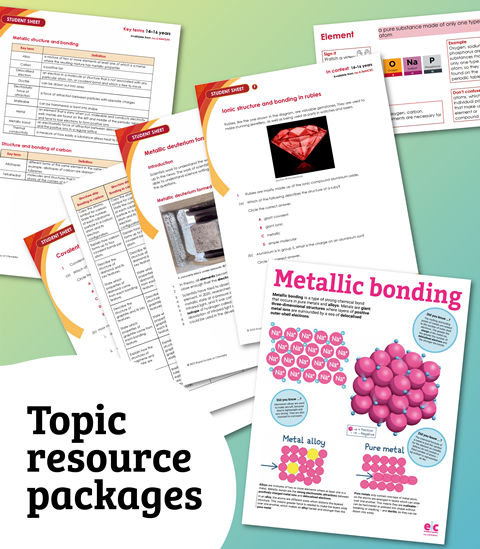
Structure and Bonding
Knowledge of structure and bonding can help explain the properties of materials. All the properties of a particular substance depend upon the elements present and how they are bonded to each other. This programme is designed to develop students understanding of structure and bonding as well as developing thinking ...
-
 Resource
On This Day – Jan 01: Eugène Demarcay was born
In 1901 he used spectroscopy to analyse material that had been carefully separated from samarium magnesium nitrate and discovered the element europium (Eu). His specialist knowledge of spectroscopy also helped Marie Curie confirm she had discovered radium (Ra). Related resources: Marie Curie and Aspects of the History of ...
-
 Resource
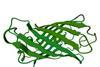
On This Day - Feb 01 : Roger Tsien was born
He shares the 2008 Nobel Prize in Chemistry with Osamu Shimomura and Martin Chalfie for their discovery of the green fluorescent protein (GFP). GFP is a protein that glows bright green in the presence of blue light and is found in Aequorea victoria jellyfish.
-
 Resource
On This Day – Jan 02 : Rudolf Clausius was born
He was one of the central founders of thermodynamics. He introduced the concept of entropy and stated the second law of thermodynamics for the first time. He also introduced concepts of kinetic theory to explain motion of gas molecules, in particular the mean free path of particles.