











Support learners to develop mental models of chemical equations that include the formula of ionic compounds
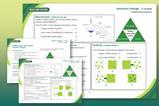
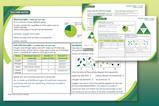
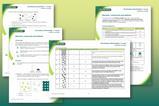
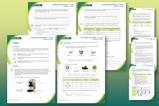
Developing understanding is a series of resources that encourage learners to connect their thinking at the macroscopic, sub-microscopic and symbolic levels. This resource, which includes teacher notes and a student worksheet, is designed to help learners develop mental models of what is represented by a balanced chemical equation that includes the formula of an ionic compound.
-
Download this
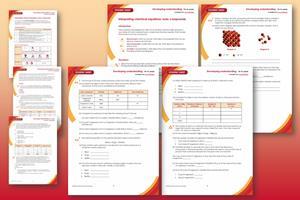
A ramped worksheet to help learners develop their mental models of what is represented by a balanced chemical equation that includes the formula of an ionic compound. With icons to indicate the conceptual level/s of each question.
View and download more Developing understanding worksheets
Learning objectives
- Link the formula and state symbol of reactants and products to observations of a chemical reaction.
- Interpret the meaning of the formula of different ionic compounds.
- Interpret a chemical equation to identify the structure of each reactant and product and whether each is made up of atoms, molecules or ions.
- Recognise that a chemical equation can be used to work out the mass of product that could be produced from the given mass of a reactant.
How to use this resource
This resource aims to develop learners’ understanding of how balanced chemical equations show the ratio in which atoms, molecules and ions of different substances react or are produced. The questions encourage learners to think about how the chemical formula and state symbol of elements and compounds connect to their structure and what is observed during a chemical reaction. The final question encourages learners to think about how a balanced chemical equation can be used to determine the mass of substances that react or are produced. As a result, learners should develop more secure mental models to support their thinking about this topic.
- When to use? Use after initial teaching or discussion of this topic to develop ideas further. You can also use as a revision activity.
- Group size? Suitable for independent work either in class or at home. Or use the questions for group or class discussions.
- How long? 15–30 mins.
Johnstone’s triangle
Johnstone’s triangle is a model of the three different conceptual levels in chemistry: macroscopic, symbolic and sub-microscopic. You can use Johnstone’s triangle to build a secure understanding of chemical ideas for your learners.
Introduce learners to Johnstone’s triangle with our Magnesium and oxygen reaction Johnstone’s triangle worksheet, which guides learners to recognise chemical formulas and symbols in equations and describe what is being shown in a balanced chemical equation.
Further reading
Read more about how to use Johnstone’s triangle in your teaching with these articles:
- Develop deeper understanding with models
- Improve students’ understanding with Johnstone’s triangle
- Practical ideas for using Johnstone’s triangle
Norman Reid’s book The Johnstone triangle: the key to understanding chemistry provides an more in-depth overview, the first chapter is available to read online.
Scaffolding
This worksheet is ramped so that the earlier questions are more accessible. The activity becomes more challenging in the later questions. You can give extra explanations for the more challenging questions. If completing as an in-class activity it is best to pause and check understanding at intervals, as often one question builds on the previous one.
It is useful for learners to observe macroscopic properties first-hand. You could run a class practical of relevant chemical reactions or carry out a teacher demonstration. It is important that learners can observe the detail of the reactions so a camera may be useful.
It may be helpful to learners to show them a physical model or a digital image of a simple ionic lattice such as sodium chloride which can be rotated.
Additional support may be needed for any learners still lacking in confidence in the required symbolic representation. Increasing fluency in recognising symbols and common formulae through quizzing may be beneficial, along with matching to the physical appearance of elements and compounds to improve recognition.
Answer guidance
There are five multi-part questions in the student worksheet. Answers are found in the teacher guidance.
Question one develops learners’ understanding of how observations of the formation of a product (macroscopic understanding) connect to a chemical formula and state symbol (symbolic understanding).
Question two develops learners’ understanding of the connection between the chemical formula of an ionic compound (symbolic understanding) and the ratio of the large number of ions that make up its ionic lattice structure (sub-microscopic understanding).
Question three develops learners’ understanding by supporting them to apply the idea of a ratio of ions (sub-microscopic understanding) to ionic compounds with different chemical formulas (symbolic understanding).
Question four develops learners’ understanding of how to connect a chemical formula and state symbol (symbolic understanding) to the structure of the element or compound (sub-microscopic understanding). This can then be used to determine whether the element or compound is made up of atoms, molecules of ions and the relative number of each.
Question five develops learners’ understanding of how a balanced chemical equation (symbolic understanding) shows the ratio of the number of atoms and ions (in moles) that react or are produced (sub-microscopic understanding). Learners are then supported to connect this to the mass of substances that react or are produced (macroscopic understanding). If learners do not need to learn about moles, this question could be omitted.
Downloads
Interpreting ionic equations developing understanding student sheet
Handout | PDF, Size 0.27 mbInterpreting ionic equations developing understanding teacher notes
Handout | PDF, Size 0.27 mbInterpreting ionic equations developing understanding student sheet
Editable handout | Word, Size 0.65 mbInterpreting ionic equations developing understanding teacher notes
Editable handout | Word, Size 0.47 mb
- Prepare(3)
 CPD article
Teaching conservation of mass at 14–16
Help learners master the concept of conservation of mass with these hands-on teaching ideas
 Ideas
Ideas5 effective ways to teach balancing equations
Tried-and-tested approaches to build student skills and confidence
 Course
Quantitative chemistry | Self-led course
Build confidence in your quantitative chemistry knowledge and discover effective topic-specific teaching strategies
- Deliver(7)
 Poster
How to balance chemical equations
Simple steps to success, confidence and fluency with balancing equations for 14–16 learners
 Resource
Balanced chemical equations | Structure strip | 14–16 years
Use scaffolded prompts to support learners to write about balanced chemical equations
currently reading
 Resource
Interpreting chemical equations for ionic compounds | Developing understanding | 14–16
Help your learners develop mental models of what is represented in balanced chemical equation for ionic compounds with this resource, including teacher notes and a student worksheet
 Resource
Balancing chemical equations using magnesium and oxygen | Johnstone’s triangle worksheets | 14–16 years
Introduce Johnstone’s triangle with these teacher notes and a student worksheet to help learners gain a deeper understanding of balancing chemical equations
 Resource
Interpreting chemical equations | Developing understanding | 14–16 years
Deepen learners’ understanding of interpreting chemical equations by exploring the topic at different conceptual levels
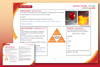 Resource
Balancing chemical equations using hydrogen and oxygen | Johnstone’s triangle worksheets | 14–16 years
Introduce Johnstone’s triangle to help learners gain a deeper understanding of balancing chemical equations
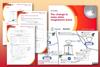 Class experiment
The change in mass when magnesium burns
A class practical to find the formula of magnesium oxide using the change in mass when magnesium burns
- Literacy(1)
 Resource
Quantitative chemistry | Key terms support | 14–16
Language support pack for quantitative chemistry, with key terms list, accessible glossary, Frayer models and unscrambling definitions
- Assess(4)
 Resource
Balanced chemical equations and fuel | In context | 14–16
Put balancing chemical equations into context with questions based on fuels
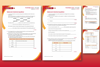 Resource
Balanced chemical equations | Knowledge check | 14–16
Ready-to-use worksheets to assess learning of balancing chemical equations, foundation and higher level
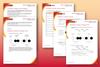 Resource
Quantitative chemistry | Review my learning | 14–16 years
A set of differentiated worksheets with answers to identify learning gaps and misconceptions on the topic of quantitative chemistry
 Quiz
QuizSymbols, formulas and balanced equations | Bridging the knowledge gap | 14–16 years
Support your students with the transition to post-16 study with this quiz on symbols, formulas and balanced equations
- Enrich(2)
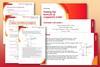 Class experiment
Finding the formula of copper(II) oxide
Use this demonstration with your 14–16 learners to deduce the formula of copper(II) oxide by reducing it with methane
 News
NewsMaking ammonia production greener
Could lasers offer a more sustainable alternative to the Haber process



No comments yet