







Microscale chemistry practicals provide plenty of variety and opportunity to refine practical skills
Following integrated instructions, learners will observe the dissolution of the crystals, colour change of the indicator and formation of the product.
This resource supports Teaching observation skills at 11–14 and Explicitly teach learners how to make observations, part of the Teaching science skills series from Education in Chemistry. Both articles offer ideas and tips for supporting your learners to develop their observation skills.
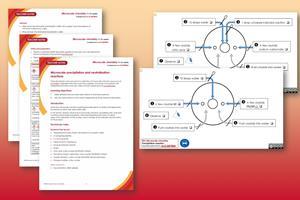
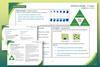
This microscale practical involves mixing chemicals in small drops of water on the instruction sheet and observing the reactions.
The potassium iodide and lead(II) nitrate(V) crystals will dissolve into the water. Yellow lead(II) iodide crystals will form in the centre of the drop over time as the ions diffuse towards each other.
From their observations, encourage your learners to make inferences on what is happening at the sub-microscopic level as the solid dissolves, the ions diffuse, and a new insoluble substance is produced.
-
Download this
Download the teacher and technician notes as MS Word or pdf and the student integrated instructions as MS PowerPoint or pdf.
Intended outcomes
- Make detailed and accurate observations of chemical reactions.
- Use your observations to infer what is happening as these reactions take place.
Equipment
- Integrated instruction sheets, laminated or in a plastic wallet
- 2 x dropping pipettes
- 2 x micro spatulas
- Paper towel for clearing up
- Universal indicator solution
- Water
- Citric acid, a few crystals (WARNING: irritant)
- Anhydrous sodium carbonate, a few crystals (WARNING: irritant)
- Lead(II) nitrate(V), a few crystals (DANGER: harmful and toxic)
- Potassium iodide, a few crystals
- Eye protection: safety glasses to EN166 F
Health and safety
- Read our standard health and safety guidance and carry out a risk assessment before running any live practical. If in doubt, contact your school health and safety advisor.
- Check CLEAPSS/SSERC or another reputable source for full risk assessment guidance. Hazard classification may vary depending on the supplier.
- Wear eye protection (safety glasses to EN166 F).
- Ensure hands are washed after the activity.
- See the downloadable technician notes for further health and safety advice about the chemicals used in this practical.
Method
Reaction 1: Precipitation of lead iodide
- Add a few crystals of potassium iodide to the left-hand small circle.
- Add a few crystals of lead(II) nitrate(V) to the right-hand small circle.
- Add 10 drops of water to the large central circle.
- Carefully push the crystals into the edges of the water. Observe the dissolution of the crystals and the formation of lead iodide.
Example reaction
Reaction 2: Neutralisation of citric acid
- Add a few crystals of anhydrous sodium carbonate to the left-hand small circle.
- Add a few crystals of citric acid to the right-hand small circle.
- Add 10 drops of water to the large central circle. Add 1 drop of universal indicator solution to the water.
- Carefully push the crystals into the edges of the water. Observe the dissolution of the crystals, the change in colour of the indicator and the formation of carbon dioxide bubbles.

This resource is part of our Teaching science skills series, bringing together strategies and classroom activities to help your learners develop essential scientific skills, from evaluation to ethics.
Example reaction
Disposal
Wipe down the laminated sheet/plastic wallet with a paper towel and dispose of the towel in laboratory waste.
More resources
- Show your learners the difference between observation and inference using our Tricky tracks resource.
- Our microscale collection has more information and tips, plus lots more microscale experiments.
- Inspire keen observation skills with stories of accidental discoveries that impact our daily lives.
- Watch a close-up video demonstration of miscroscale displacement reactions of iron, copper and zinc reacting.
- Help students connect observations to theory with useful activities and approaches to deepen understanding at macro, sub-micro and symbol levels.
- Introduce your learners to Ben, who is observing how oceans are responding to climate change to protect our marine environments.
Downloads
Microscale precipitation and neutralisation teacher and technician notes
Handout | PDF, Size 0.24 mbMicroscale precipitation and neutralisation integrated instructions
Presentation | PDF, Size 0.42 mbMicroscale precipitation and neutralisation teacher and technician notes
Editable handout | Word, Size 0.45 mbMicroscale precipitation and neutralisation integrated instructions
Presentation | PowerPoint, Size 0.3 mb
- Prepare(2)
 Ideas
IdeasExplicitly teach learners how to make observations
How to give students the skills to describe and explain what they see scientifically
 Course
Particle and atomic models | Self-led course
Strengthen your subject knowledge and discover teaching strategies to develop your learners’ understanding of the particle model and atomic structure
- Deliver(7)
 Resource
Diffusion and chemical reactions | Developing understanding | 11–14 years
Use this worksheet to deepen understanding of diffusion and chemical reactions and how these processes are represented
 Resource
Diffusion and dissolving | Developing understanding | 11–14 years
Deepen learners’ understanding of diffusion and dissolving with this worksheet exploring different conceptual levels of thinking
 Resource
Diffusion | Structure strip | 11–14 years
Use scaffolded prompts to support learners to write about diffusion
 Class experiment
Microscale diffusion of a gas | 11–16 years
Explore diffusion with this simple and effective microscale experiment
 Exhibition chemistry
Dissolve coloured sweets to create a rainbow
Demonstrate diffusion, density and the particle model to your 14–16 learners in this easy experiment
currently reading
 Resource
Microscale precipitation and neutralisation reactions | 11–16 years
Improve learners’ practical skills by using these microscale experiments to observe a neutralisation and precipitation reaction.
 Class experiment
Diffusion of gases – a safer alternative to bromine
Diffusing gases can be a tricky thing to do, but by creating an alternative to bromine, you can make a safer classroom alternative for this process. Kit list and safety instructions included.
- Literacy(3)
 Resource
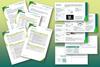
Particle model | Key terms support | 11–14
Language support pack for particle model, with key terms list, accessible glossary, Frayer models and unscrambling definitions
 Resource
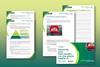
Particle model | Reading comprehension | 11–14 years
Use this reading comprehension based on a real science research news story to develop literacy skills and confidence
 Resource
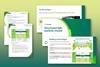
Particle model | Structured talk | 11–14 years
In this speaking and listening task learners work together to build word bridges, building and sharing understanding by applying the particle model
- Enrich(4)
 Feature
Sniffing out the science of smells
What makes a bad smell smell bad? Sniff out the chemical culprits behind obnoxious odours
 Job profile
Dermal toxicologist
Hazem explores how harmful substances can affect the skin and sometimes enter the body.
 Job profile
Principal air quality consultant
Saba’s air quality assessments help clients worldwide to minimise their air pollution
 Job profile
Senior principal scientist
Misbah uses computers to predict which catalysts will be best at removing harmful pollutants from road-using vehicles


1 Reader's comment