



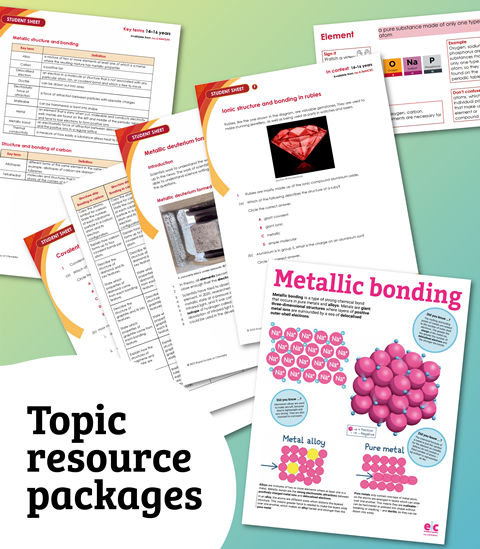







Everything you need to support learners to develop key understanding number skills in a chemistry context
This flexible set of resources supports you to build confidence and capability for all your learners in this key area of maths for chemistry.
Download the resources below, and see our guidance on how to use them.
-
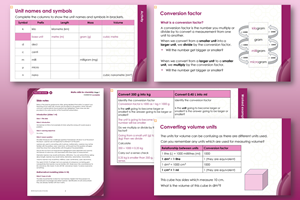
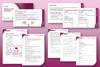
Teacher-led presentation
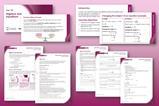
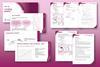
A carefully structured lesson to build skills and model their application to chemistry
-
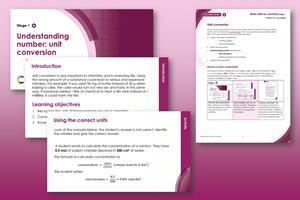
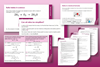
Short activities
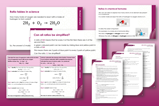
A set of quick activities to engage and embed skills, use as lesson starters or for recap
-
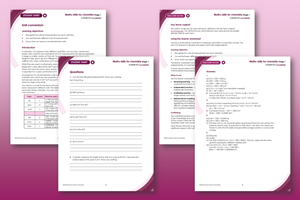
-
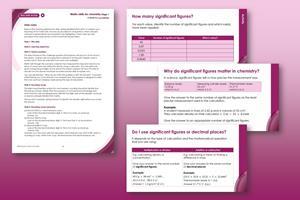
Teacher-led presentation
A carefully structured lesson to build skills and model their application to chemistry
-
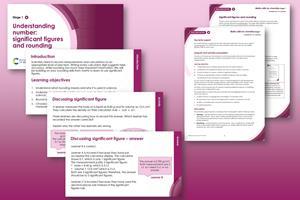
Short activities
A set of quick activities to engage and embed skills, use as lesson starters or for recap
-
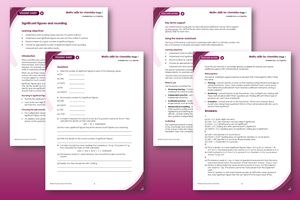
Unit conversion
Significant figures and rounding
Explore the full series Maths skills for chemistry
Introduction
This pack of resources supports learners to develop their understanding of number in chemistry. The resources build on what students have learnt in maths and supports them to apply that in their chemistry lessons. One set covers unit conversion, with a second set for significant figures and rounding. Both topics are available at stage one only.
These resources are part of a series that covers mathematical skills which are fundamental to chemistry teaching. Other topics in the series:
- Graphs and data, divided into:
- Ratio and proportion
- Algebra and equations
Support for the language of mathematics
Key mathematical vocabulary for each skill area is defined in the key terms support. Find the key terms listed by topic area and an accessible glossary slide for each term.
Learning objectives
Unit conversion
- Recognise the units of measurements we use in chemistry.
- Convert between different units of measurement.
- Know when we need to convert between units.
Significant figures and rounding
- Understand what rounding means and why it is used in science.
- Understand what significant figures are and why they matter in science.
- Round numbers to a given number of significant figures.
- Choose an appropriate number of significant figures when recording measurements and carrying out calculations.
How to use the resources
Teacher-led presentation
This is a full lesson focused on mastering maths skills in a chemistry context. The aim is for learners to develop key skills and then begin to apply these independently.
As you move through the presentation, there is a clear progression in skill development. The first slides engage learners’ prior knowledge of the chosen maths skills. These slides link back to their learning from maths lessons as well as prior chemistry knowledge, where applicable.
Following this, the slides move onto some maths−chemistry translation tasks, then learners complete activities within a chemistry context.
The teacher-led presentation is designed to be used:
- prior to teaching a topic which makes explicit use of the maths skill, e.g. for significant figure and rounding, this might be alongside practical work or calculations with results to multiple decimal places
- after summative assessment as an intervention.
Extensive guidance is offered for each slide so that you can model mathematics and translate between maths and science contexts with confidence.
Short activities
The aim of the short activities is for learners to revisit and practise skills from the teacher-led presentation and to develop problem solving skills so they can apply these independently.
As you move through the activities, there is a clear progression in skill development. The first activity or activities engage learners’ prior knowledge of the chosen maths skill. Following this, learners will complete activities within a chemistry context.
Activities can be teacher-led, for learners requiring additional support or modelling, or can be set as independent work.
Each presentation contains a set of short activities that are designed to last 5–15 minutes and to be used as:
- a starter activity to engage prior knowledge or to practise a skill
- an assessment tool, used at the beginning of a lesson or sequence of work
- follow-up independent practice during lessons or plenary
- retrieval practice.
Teacher notes offer support and guidance for each activity.
Learner worksheet
The learner worksheets help students to develop and apply maths skills independently. They complement the teacher-led presentations but can function independently, for example as a classroom activity or homework assignment.
Use the learner worksheets for:
- Reviewing learning – if learners are confident with the mathematical skill, use the worksheets as a tool to review learning and assess learners’ skill level.
- Independent practice – provide learners with the worksheet to use as independent practice.
- Scaffolded practice – break the worksheet into sections and complete over a longer period, such as multiple lessons.
- Mathematical modelling – for those requiring additional support, talk through the initial questions pulling out the mathematical skills used to answer the question, highlighting and defining any key terms. If learners are still finding the task difficult, consider fading the initial questions and asking learners to complete the later questions independently.
Scaffolding
Like all of the resources in this set, the worksheets present a clear progression in skill development. Each one starts with a recap of key knowledge and a worked example. The first question engages prior knowledge of the chosen maths skill. Following this, learners will do some maths–chemistry translation tasks, then complete questions in a chemistry context.
Downloads
Teacher presentation significant figures stage 1 slides
Handout | PDF, Size 0.53 mbTeacher presentation significant figures stage 1 teacher notes
Handout | PDF, Size 0.52 mbShort activities significant figures stage 1 slides
Handout | PDF, Size 0.31 mbShort activities significant figures stage 1 teacher notes
Handout | PDF, Size 0.55 mbWorksheet significant figures stage 1 student sheet
Handout | PDF, Size 0.17 mbWorksheet significant figures stage 1 teacher notes
Handout | PDF, Size 0.4 mbTeacher presentation significant figures stage 1 slides
Editable handout | PowerPoint, Size 7.9 mbTeacher presentation significant figures stage 1 teacher notes
Editable handout | Word, Size 0.22 mbShort activities significant figures stage 1 slides
Editable handout | PowerPoint, Size 1.91 mbShort activities significant figures stage 1 teacher notes
Word, Size 0.23 mbWorksheet significant figures stage 1 student sheet
Editable handout | Word, Size 65.81 kbWorksheet significant figures stage 1 teacher notes
Editable handout | Word, Size 0.19 mbTeacher presentation unit conversion stage 1 slides
Handout | PDF, Size 0.71 mbTeacher presentation unit conversion stage 1 teacher notes
PDF, Size 0.5 mbShort activities unit conversion stage 1 teacher notes
PDF, Size 0.47 mbShort activities unit conversion stage 1 slides
Handout | PDF, Size 0.32 mbWorksheet unit conversion stage 1 student sheet
Handout | PDF, Size 0.15 mbWorksheet unit conversion stage 1 teacher notes
Handout | PDF, Size 0.5 mbTeacher presentation unit conversion stage 1 slides
Editable handout | PowerPoint, Size 13.19 mbTeacher presentation unit conversion stage 1 teacher notes
Editable handout | Word, Size 0.21 mbShort activities unit conversion stage 1 slides
Editable handout | PowerPoint, Size 2.17 mbShort activities unit conversion stage 1 teacher notes
Editable handout | Word, Size 0.22 mbWorksheet unit conversion stage 1 student sheet
Editable handout | Word, Size 69.22 kbWorksheet unit conversion stage 1 teacher notes
Editable handout | Word, Size 0.22 mb



No comments yet